

Most querying writers have heard the term query trenches. Sending out your first query letter to an agent earns you the right to post, “I’ve entered the querying trenches!” to all your social media. Receive a rejection? You’re “Officially in the querying trenches now!” Get an offer of representation? Congratulations, you’ve left the querying trenches behind.
I’ve also heard it referred to as a querying journey, and while I agree with both terms—querying can feel like a battle and can be a long and winding road full of detours—I like to equate my querying experience to a roller coaster: it was slow to start, yet ultimately it was faster than some journeys, and not as fraught as other querying stories I’ve heard. It had exhilarating highs and stomach-twisting lows. It was scary as hell. Did I mention I hate roller coasters?
I wrote my first novel ever in 2020, a young adult fantasy about twins on opposing sides of a prophecy, one led to believe she will cause the destruction of her kingdom, the other raised to believe he will be its savior, but haunted by the idea that there has been a mistake over who will play which role.
I started outlining and brainstorming in October so I could have my idea ready for NaNoWriMo (National Novel Writing Month) on November 1st. It felt good after not writing for years. I bought a laptop to work on instead of a tablet. I downloaded a free trial of Scrivener. I was committed. I was ready.
I wrote 50,000 words that November (50,280 to be precise) and “won” NaNoWriMo. But 50,000 words didn’t get me to the end of my story, so I set a new goal to finish the first draft. I kept writing, and added 37,182 words in December. I got to the end. And then I didn’t touch it for three months. In April, I did CampNaNo to edit. I cut and changed and added another 22,565 words, but I still wasn’t done with the second draft. So I made another challenge and spent May and June finishing my second draft. I logged 48,972 words. In total, I wrote about 159,000 words to land at my 98,000 word count.
I spent the next five months editing my pages and writing my first query letter. I read through the extensive QueryShark archive. I lurked and posted on Reddit’s PubTips community. I used Alexa Donne’s examples of successful queries and the hook/book/cook method to draft and redraft my own letter. I made my agent spreadsheet. I read for comp titles.
On November 15, 2021 I sent out my first batch of six queries. I would go on to send fifty queries total, from that first query in November to my last query sent on June 30, 2022. I ended up with two partial requests, one that turned into a rejection and one that turned into a full request (more on that later).
Meanwhile, I had started working on my next book, an adult speculative about a time traveler and an immortal woman who meet across time and fall in love over the centuries. This one required more prep work for the historical aspects, so I did a lot of note taking and mapping before November in preparation for NaNoWriMo 2021. I went though a lot of index cards.
But NaNoWriMo 2021 was a flop. I don’t know if it was because of the research heavy nature of the story or if I was being more particular about the words I was putting down, but this book did not want to be written in two months. I logged 21,149 words in November, not even half of my 50,000 word goal. It took me until the end of May 2022 to finish my first draft of about 110,000 words. I let it sit for a month before going back to it. This draft was cleaner than my draft had been from my first NaNo, and I’ve since come to the conclusion that I prefer to write slower and with more intention, even in the first draft—something I wouldn’t have known without the experience of my first book.
After editing for three months, I decided I wanted to query. My YA still had one full out, but in my heart I was expecting a rejection. So, I thought I’d test the water with my new book and my new query. I picked a list of people who seemed like a great fit for my new manuscript, and a few of them only requested the query letter be sent first. I thought it would be the perfect way to test if my query was working. On October 12, 2022 I sent out my first query letter.
Reader, I had a full request six minutes later.
I was in shock. Elated, but shocked. It seemed like a good sign, so I sent out a total of 15 queries instead of the 5 I had originally intended. My roller coaster cart had officially left the station.
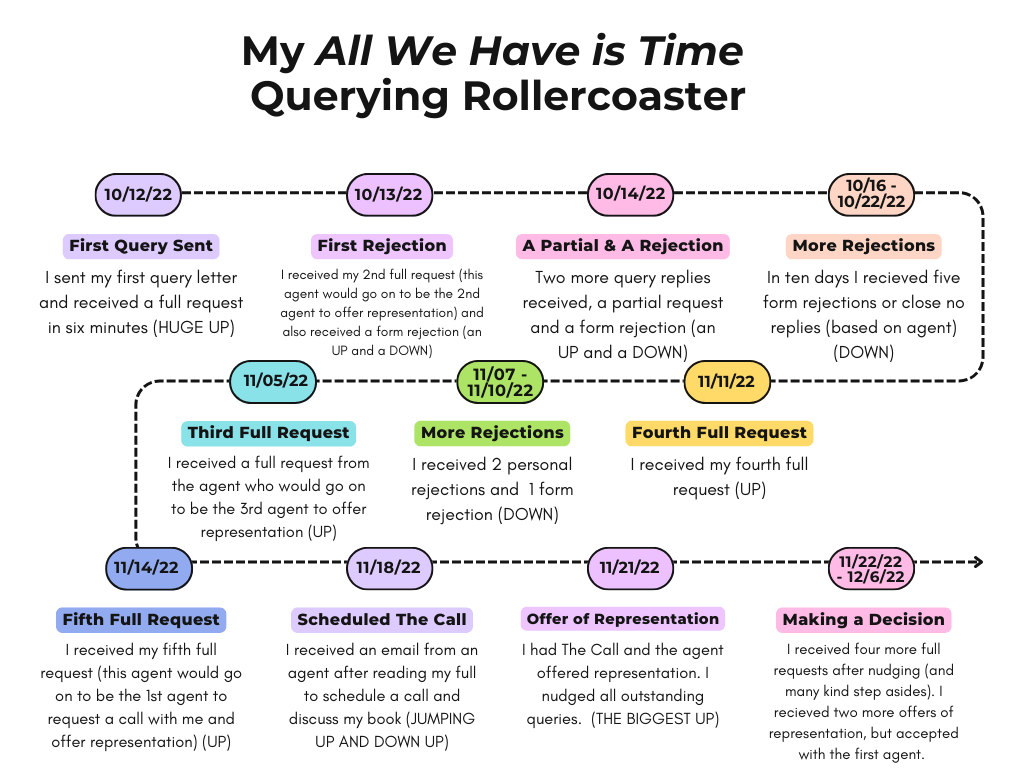
In the end, I sent 35 queries for my second book. I received nine full requests (four of those came in after nudging with an offer) and had three offers of representation. The entire querying rollercoaster for this book took about eight weeks. Yes, it was relatively short compared to others, but I still received form rejections on the same day as full requests. I still had requests that turned into rejections. Just like every book is not for every reader, every project is not for every agent. All this to say, everyone’s querying experience will be different, whether you are in the trenches or on a journey or riding a roller coaster or maybe something else entirely. It’s hard not to compare yourself to others, but try not to. No two querying experiences are the same.
I am a firm believer that no writing is ever wasted. My first book didn’t get me an agent, but it taught me how to write a novel. It taught me how to edit and pace a long form story, how to find my voice and write a query letter. It taught me how to be brave enough to send out my work to complete strangers. How to accept rejection. How to persevere.
I once attempted to explain to an acquaintance over brunch how the process of getting an agent for your book works. She compared querying to handing someone your heart. To me, this is the best metaphor for querying, more than being in the trenches, more than a journey from point to point that could be short or long, winding or straight, more than a quick, if unpredictable, roller coaster ride.
Querying is handing your heart to an agent and saying, “Here. I hope you love this as much as I do.” As an author, you will hand your heart out again and again—to agents when you’re querying, to editors when you’re on submission, and to readers when you debut. And you will be rejected again and again. It is part of being a writer. But if you are persistent, if you are lucky, you will find the people who say, “Yes, I love this as much as you do.”


Leave a comment